





Every six months, someone publishes another “Ultimate AWS vs Azure vs GCP Comparison”, and every six months, it’s the same useless content.
They show you a feature matrix. They tell you AWS has “200+ services”. They mention that Azure “integrates well with Microsoft tools”. They conclude that GCP is “great for data analytics”. They end with a sponsored CTA to sign up for a free tier.
None of it helps you make an actual decision.
I’ve built and deployed production systems on all three platforms — web applications, CI/CD pipelines, containerised microservices, managed databases — for clients ranging from early-stage startups to established SMEs. I don’t have an affiliate deal with any of them. What I have is a real cost breakdown, a set of production-learned opinions, and zero incentive to tell you anything other than the truth.
Here is the honest breakdown.
First, the market reality in 2026
Before the technical comparison, you need to understand what the market actually looks like right now — because market share tells you something important about ecosystem maturity and talent availability.
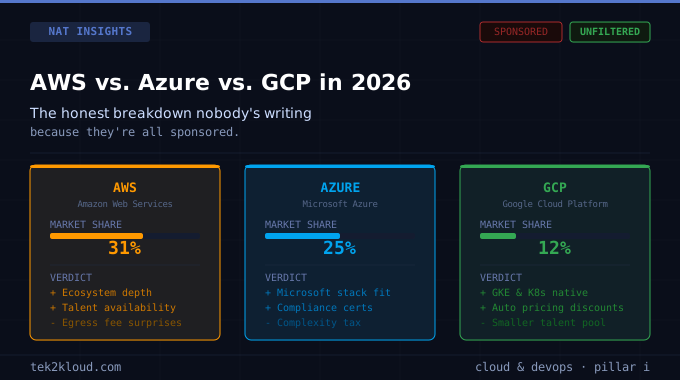
AWS holds approximately 31% of the global cloud market in 2026, followed by Azure at 25% and GCP at 12%. Together, the three control roughly two-thirds of all global cloud infrastructure spending.
But raw market share is only half the story. Azure is growing faster in enterprise adoption, while GCP leads in AI and ML services growth. And perhaps the most telling statistic for anyone making infrastructure decisions: multi-cloud adoption has hit 89% among enterprises in 2026, up from 76% in 2024.
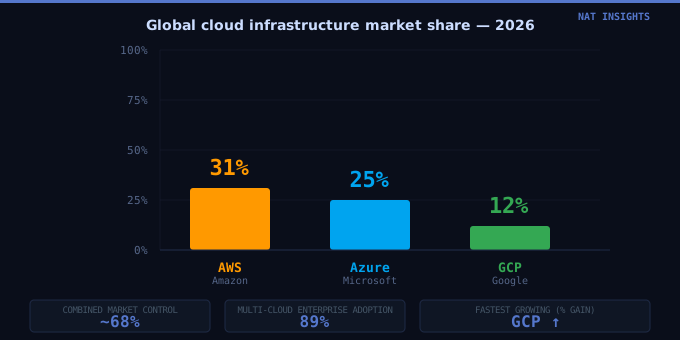
That last number matters. It means the question is increasingly not “Which cloud?” but “Which cloud first — and what does your architecture look like when you inevitably add a second?”
The real cloud decision isn’t about features. It’s about which platform’s failure modes you can afford to deal with at 2am.
AWS: The Market Leader That Will Quietly Bleed You Dry If You’re Not Careful
Let’s start with the dominant player.
AWS leads on service breadth with 200+ managed services, the largest partner ecosystem, and the most community resources of any provider. If you need a service, AWS almost certainly has it. If you hit a problem, someone on Stack Overflow hit it three years ago and documented the solution.
That maturity is genuinely valuable — especially for smaller teams who can’t afford to debug undocumented edge cases in production.
Where AWS dominates:
- General-purpose workloads where ecosystem breadth matters
- Teams that need battle-tested managed services (RDS, ElastiCache, SQS)
- Startups that want access to AWS Activate credits and startup programs
- Any workload where talent availability is a concern — AWS-certified engineers are the most available globally
Where AWS quietly costs you:
This is the part nobody in a sponsored article will tell you directly.
AWS’s pricing model is deliberately complex. The on-demand rates look reasonable until you start moving data. Egress fees — what AWS charges you to move data out of their infrastructure – are where teams consistently get surprised.
bash
# What a developer thinks their AWS bill covers:
EC2 instances + RDS + S3 storage = predictable monthly cost

# What the AWS bill actually includes:
EC2 + RDS + S3 + NAT Gateway data processing
+ inter-AZ data transfer + CloudWatch logs ingestion
+ API Gateway requests + data transfer OUT to internet
= "why is this $400 more than last month?"
The NAT Gateway charge in particular catches teams building VPC-based architectures. Data processing through a NAT Gateway costs $0.045 per GB — which sounds negligible until you have a containerised application generating significant internal traffic.
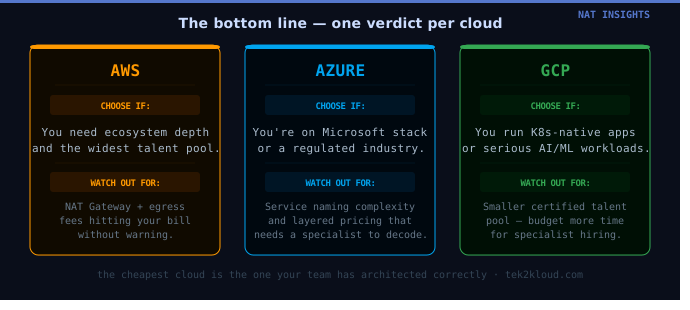
The AWS verdict: Right for teams that need ecosystem depth, can invest time in cost optimisation, and are building workloads where the talent market matters. Wrong for teams that want pricing predictability without a dedicated FinOps function.
AWS is the cloud equivalent of a city with everything you need — and parking that will ruin your month if you don’t pay attention.
Azure: The Enterprise Workhorse With a Complexity Tax
Azure is the right cloud for a specific type of organisation. The problem is that Microsoft’s marketing makes it sound like the right cloud for every organisation.
Azure holds approximately 23–25% of the global market and is growing fastest in absolute revenue terms, driven by Microsoft 365 integration, an exclusive OpenAI partnership, and the most compliance certifications of any cloud provider. Research.com
That Microsoft 365 integration is Azure’s genuine superpower — and it’s only valuable if you’re already living in the Microsoft ecosystem.
Where Azure genuinely wins:
If your organisation runs Windows Server workloads, Active Directory, SQL Server, or Microsoft 365, Azure is not just convenient — it’s meaningfully cheaper and operationally simpler. The hybrid connectivity between on-premise Microsoft infrastructure and Azure cloud is mature in a way that AWS and GCP simply cannot match because they don’t control the on-premise stack.
Azure also leads on compliance certifications — critical for teams in regulated industries like healthcare, finance, and government. If your workload requires ISO 27001, SOC 2, HIPAA, or regional data sovereignty compliance, Azure has the broadest certification coverage. Research.com
Where Azure charges you a complexity tax:
Azure’s service naming is notoriously confusing — a legacy of Microsoft acquiring and rebranding services over many years. “Azure Kubernetes Service,” “Azure Container Instances,” “Azure Container Apps,” and “Azure App Service” all handle containerised workloads in overlapping but meaningfully different ways. Navigating this correctly requires experience — and mistakes here translate directly into cost.
Many teams exploring Azure aren’t looking for more features — they’re looking for less complexity. Azure’s enterprise-focused services and layered pricing can make it challenging to predict costs or move quickly. Sprout Social
For a small or mid-sized team without dedicated Azure expertise, the learning curve creates real operational overhead that erodes the productivity advantage you were looking for in the first place.
The Azure verdict: Right for Microsoft-stack enterprises, regulated industries, and teams building on OpenAI models through Azure OpenAI Service. Wrong for lean teams, early-stage startups, and anyone who wants billing they can understand without a specialist.
GCP: The Underdog Advantage Most People Are Still Sleeping On
Google Cloud is where I consistently see the most value being left on the table by developers who dismissed it as a distant third and never looked back.
GCP holds approximately 11–12% of the global market but is growing fastest by percentage. It offers best-in-class Kubernetes via GKE, BigQuery for data analytics, and Google’s private global network backbone. Research.com
Let me break down what “Google’s private global network backbone” actually means in practical terms, because this is GCP’s most underrated advantage.
GCP’s primary differentiator is its private subsea fibre network, which routes traffic away from the public internet to provide more consistent global latency. When your application traffic routes over Google’s private infrastructure rather than the public internet, you get more predictable performance — especially for globally distributed applications where latency variance matters. Sprout Social
Where GCP wins outright:
Kubernetes. GKE (Google Kubernetes Engine) is the most mature managed Kubernetes service available. This isn’t opinion — Kubernetes was invented at Google, open-sourced from their internal Borg system, and GKE reflects a decade of production learning that AWS EKS and Azure AKS are still catching up to.
Pricing transparency. GCP is typically 5–10% cheaper for equivalent compute due to automatic sustained-use discounts. Unlike AWS Reserved Instances (which require 1–3 year commitments) or Azure Reserved VM Instances, GCP applies sustained-use discounts automatically when you run instances for more than 25% of a month. No upfront commitment. No configuration required.
AI and ML workloads. For AI workloads specifically, GCP remains 5–10% cheaper than AWS and Azure, with custom TPU hardware for ML training at competitive price-performance.
Where GCP falls short:
The talent market. AWS-certified engineers are everywhere. GCP-certified engineers are a smaller pool, which means hiring for GCP expertise costs more and takes longer. For teams that need to scale engineering headcount quickly, this is a real operational constraint.
The managed services depth also trails AWS — not in core infrastructure, but in the long tail of specialized services where AWS has been building for 20 years.
The GCP verdict: Right for teams building Kubernetes-native architectures, data-heavy workloads, AI/ML pipelines, and any team that wants competitive pricing without the Reserved Instance commitment game. Wrong for teams where talent availability and hiring speed are primary constraints.
The cheapest cloud isn’t the one with the lowest sticker price. It’s the one your team has architected correctly.
The Question Nobody Asks But Should
Most cloud comparison articles end with a recommendation. I want to end with a question that will actually move your decision forward.
What does your team’s operational overhead look like on each platform — not just today, but at 3x your current scale?
The right cloud is the one your team can operate confidently as you grow. That means honest assessment of your current expertise, your hiring plans, and your tolerance for billing complexity.
If you’re a lean team without a dedicated DevOps function, the managed infrastructure layer matters enormously — because every hour spent firefighting cloud configuration is an hour not spent on the product. This is exactly the problem our WaaS model at Tek2Kloud addresses for small and medium businesses: production-grade managed infrastructure without the internal operational overhead. If that’s a conversation worth having for your business, tek2kloud.com is where to start.
For the rest of you — pick a cloud, build something real on it, and let the production experience teach you what no comparison article can.
Nathaniel Edet is a Cloud/DevOps Engineer and founder of Tek2Kloud Solutions Ltd — a web development company and managed infrastructure provider. NAT Insights publishes weekly on cloud engineering, tech careers, and digital business strategy.
Follow NAT Insights for the next piece in this series.
Over to you:
Which cloud is your team currently on, and what’s been your single biggest frustration or surprise with it? Drop it in the comments. I’ll personally respond to every engineer who shares a specific challenge.
GCP is the cloud that rewards engineers who actually understand what they’re running — and punishes teams that just want to click through a console.
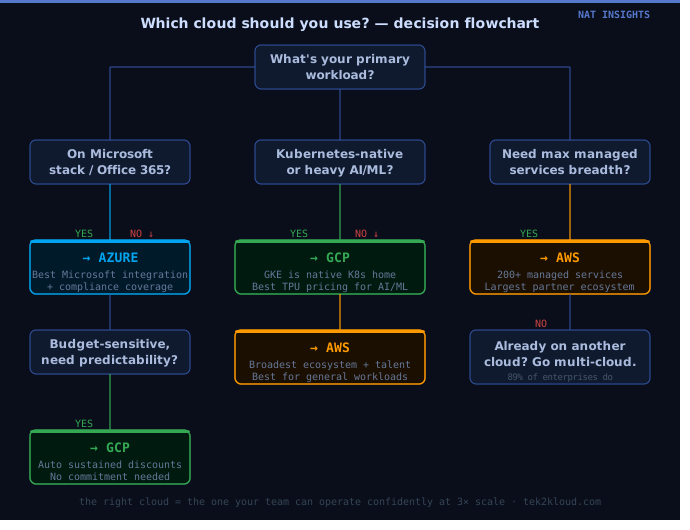
The Decision Matrix: Which Cloud for Which Use Case
Stop looking for the “best cloud”. Start asking the right questions.
| Your Situation | Recommended Starting Point |
|---|---|
| Early-stage startup, general web app | AWS (ecosystem, credits, talent) |
| Enterprise, Microsoft 365 stack | Azure (integration, compliance) |
| Kubernetes-native architecture | GCP (GKE maturity) |
| Heavy AI/ML workloads | GCP (TPU pricing, Vertex AI) |
| Regulated industry (health, finance) | Azure (compliance certs) |
| Data analytics at scale | GCP (BigQuery) |
| Multi-region, global latency sensitive | GCP (private network backbone) |
| Maximum managed service options | AWS (200+ services) |
| Budget-constrained, need predictability |
GCP (sustained-use discounts) |
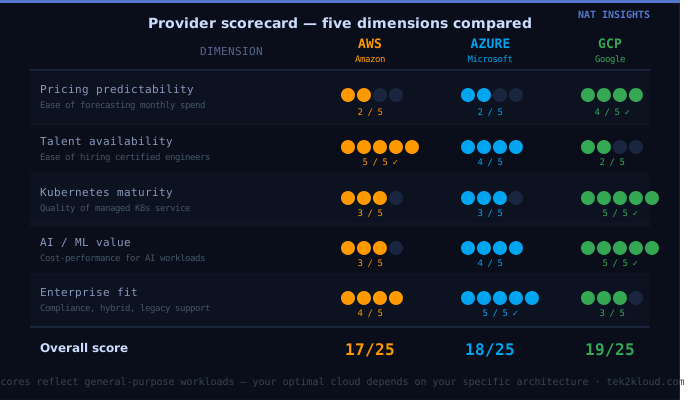
What I Actually Use — And Why
For Tek2Kloud’s production infrastructure and client deployments, we operate primarily on AWS with GCP used for specific containerized workloads.
The AWS choice is pragmatic: the talent availability, managed service depth, and partner ecosystem make it the lowest-friction option for client work across diverse industries. When a client has a specific compliance requirement or an ML-heavy workload, GCP enters the conversation.
Azure enters our stack when a client is already deeply embedded in a Microsoft enterprise environment – in which case forcing them onto AWS or GCP creates migration overhead that outweighs any technical advantage.
The honest answer is that at the small-to-mid-market scale where most teams actually operate, the cloud provider matters less than the architecture decisions you make on top of it. A well-architected application on GCP will outperform a poorly-architected application on AWS every time.
The cheapest cloud isn’t the one with the lowest sticker price. It’s the one your team has architected correctly.
The Question Nobody Asks But Should
Most cloud comparison articles end with a recommendation. I want to end with a question that will actually move your decision forward.
What does your team’s operational overhead look like on each platform — not just today, but at 3x your current scale?
The right cloud is the one your team can operate confidently as you grow. That means honest assessment of your current expertise, your hiring plans, and your tolerance for billing complexity.
If you’re a lean team without a dedicated DevOps function, the managed infrastructure layer matters enormously — because every hour spent firefighting cloud configuration is an hour not spent on the product. This is exactly the problem our WaaS model at Tek2Kloud addresses for small and medium businesses: production-grade managed infrastructure without the internal operational overhead. If that’s a conversation worth having for your business, tek2kloud.com is where to start.
For the rest of you — pick a cloud, build something real on it, and let the production experience teach you what no comparison article can.
Nathaniel Edet is a Cloud/DevOps Engineer and founder of Tek2Kloud Solutions Ltd — a web development company and managed infrastructure provider. NAT Insights publishes weekly on cloud engineering, tech careers, and digital business strategy.
Follow NAT Insights for the next piece in this series.
Over to you:
Which cloud is your team currently on, and what’s been your single biggest frustration or surprise with it? Drop it in the comments. I’ll personally respond to every engineer who shares a specific challenge.