As a DevOps Engineer. Here’s the Honest Salary Gap That Should Make Every Developer Uncomfortable.
The skills gap between a developer and a DevOps engineer is smaller than you think. The salary gap is not.
Let me give you a number that stopped me the last time I looked it up.
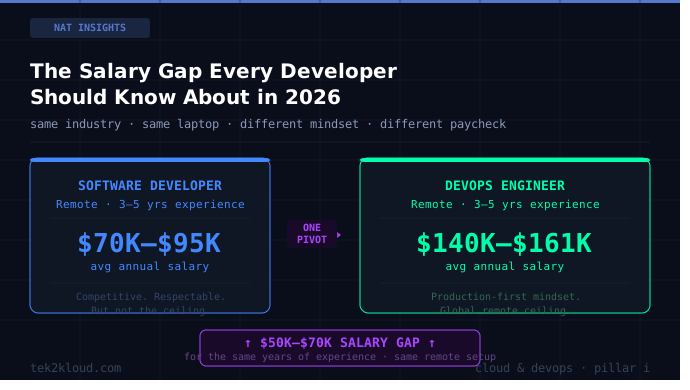
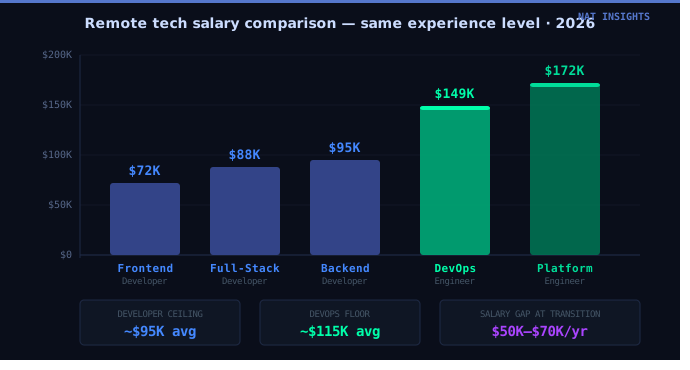
The average remote software developer salary in 2026 sits between $70,000 and $95,000 annually. Solid money. Respectable career. Nothing to dismiss.
The average remote DevOps engineer salary in 2026 sits at $161,468 — with the most common range clustering between $140,000 and $150,000.
Same industry. Same remote setup. Same laptop on the same desk.
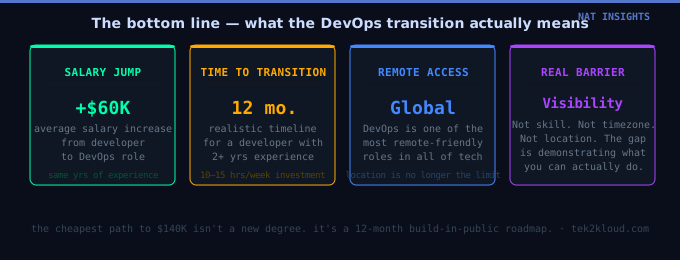
A gap of $50,000 to $70,000 per year — for a role that developers are, in many ways, already halfway qualified for without knowing it.
I’ve been in the trenches of cloud and infrastructure engineering for over four years. I’ve watched developers with genuinely exceptional skills plateau at salaries that don’t reflect what they’re worth — not because they aren’t talented, but because they haven’t made one specific career pivot that the market is currently paying a premium for.
This article is the honest breakdown of what that pivot looks like, what it actually costs you in time and effort, and exactly what to do first.
The uncomfortable truth about developer vs. DevOps salaries
Let’s put the full picture on the table before anything else.
DevOps engineers earn an average salary between $116,000 and $180,000 per year in the US, with factors like expertise, experience, industry, and certifications influencing the final number.
Platform Engineers — the next evolution of DevOps — are averaging $172,038 as of Q1 2026, roughly 20% above standard DevOps roles, in one of the thinnest talent supply categories in the market.
DevOps job growth is projected at 8% through 2032, driven by companies accelerating digital transformation and cloud migration — placing it in the highest-demand segment of engineering roles. Medium
For developers in Africa and emerging markets, the equation is even more compelling. A developer from Nigeria who polishes their GitHub portfolio and transitions into infrastructure-aware roles can land remote SaaS positions in Europe earning $5,800 per month. That number doesn’t come from front-end React work. It comes from the kind of production systems thinking that DevOps demands.
The salary gap between developers and DevOps engineers isn’t about seniority. It’s about the specific type of problem each role is trusted to solve.
Why developers are already closer to DevOps than they think
Here is the part that most career transition guides bury in paragraph nine.
Developers moving into DevOps start with the best position of anyone — they already understand code, debugging, APIs, and version control. Their advantage over sysadmins moving into DevOps is that they already think in terms of automation, abstraction, and code reuse. tek2kloud
The mental model shift is the real transition — not the tooling.
A developer asks: “Does this code work?”
A DevOps engineer asks: “Does this code work at 3am when I’m asleep, under unexpected load, with a degraded database connection, across three availability zones — and does it recover without waking anyone up?”
That shift in thinking — from “it works on my machine” to “it works in production at all times under all conditions” — is what DevOps compensation is actually paying for. The tools are learnable in months. The mindset is what separates engineers who command $140K from those who plateau at $70K.
DevOps isn’t a set of tools. It’s a production-first mindset that developers are already halfway to — without realizing it.
The honest skills gap: what you actually need to learn
Let me be specific here, because most DevOps roadmap articles list 40 tools and send you into a spiral of tutorial hell that wastes 18 months.
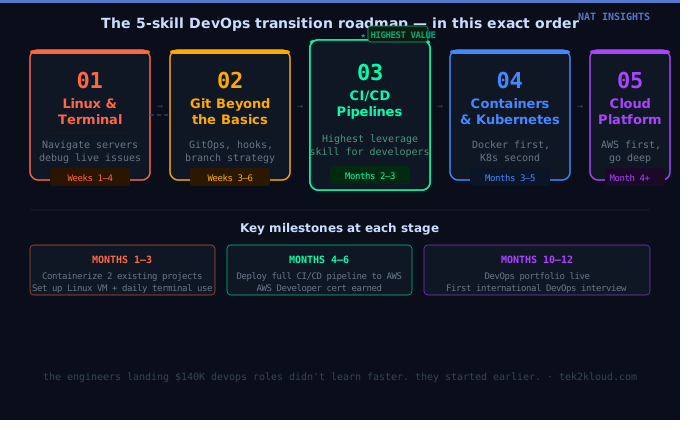
You need to develop competence in five areas. In this order.
1. Linux and the command line — non-negotiable
If you cannot navigate a Linux server under pressure, debug a failing service, and trace a network issue from the command line, you cannot operate production infrastructure. Full stop.
This is not optional and it is not something you can fake.
bash
# The commands a DevOps engineer runs daily —
# every single one of these should feel natural

systemctl status nginx          # Check service health
journalctl -u nginx -f          # Stream service logs live
netstat -tlnp                   # Check what's listening on which ports
lsof -i :8080                   # Find what's using a specific port
df -h                           # Disk usage across mounted volumes
top / htop                      # Real-time process and resource monitoring
Start here. Set up an Ubuntu VM locally using VirtualBox or spin up an AWS EC2 free-tier instance. Spend four weeks doing nothing but living in the terminal. Everything else builds on this foundation.
2. Git beyond the basics — version control as infrastructure
Most developers use Git to push code. DevOps engineers use Git to manage infrastructure, configuration, deployment pipelines, and rollback strategies.
The concepts that separate basic Git usage from DevOps-grade version control:
GitOps: using Git as the single source of truth for infrastructure state
Branch protection rules and automated merge gates
Semantic versioning applied to infrastructure releases, not just application code
Git hooks for automated testing and compliance checks before deployment
Understanding Git at this level means you can implement CI/CD pipelines — which brings us to the highest-value skill on this list.
3. CI/CD pipelines — where your developer skills compound hardest
This is the single highest-leverage skill for a developer transitioning into DevOps, because it directly applies what you already know.
A CI/CD pipeline is automated logic that takes code from a developer’s commit and moves it through testing, building, and deployment to production — without manual steps.
Here is what a basic GitHub Actions pipeline looks like for a Node.js application:
yaml
# .github/workflows/deploy.yml
# Automates: test → build → deploy on every push to main

name: CI/CD Pipeline

on:
  push:
    branches: [main]

jobs:
  test-and-deploy:
    runs-on: ubuntu-latest
    steps:
      - name: Checkout code
        uses: actions/checkout@v3

      - name: Install dependencies
        run: npm ci

      - name: Run tests
        run: npm test

      - name: Build Docker image
        run: docker build -t myapp:${{ github.sha }} .

      - name: Deploy to production
        run: |
          # Your deployment command here
          echo "Deploying version ${{ github.sha }}"
Building this kind of pipeline for your existing projects — even simple ones — is the single fastest way to demonstrate DevOps competence to an international employer.
4. Containers and Kubernetes — the universal infrastructure language
Realistic with a bootcamp: full-stack developer, front-end developer, DevOps engineer — because bootcamps give you concentrated skills and portfolio projects that matter to hiring managers. But what the bootcamps rarely teach well is containerization — which is now the default deployment method for virtually every production application at scale. ReTable
Docker is the entry point. Understand how to:
Containerize an application you’ve already built
Write a multi-stage Dockerfile that produces a lean production image
Run multi-container applications using Docker Compose
Understand networking between containers
dockerfile
# Multi-stage build — produces a lean production image
# Developer skill + DevOps thinking = this pattern

FROM node:18-alpine AS builder
WORKDIR /app
COPY package*.json ./
RUN npm ci --only=production

FROM node:18-alpine AS production
WORKDIR /app
COPY --from=builder /app/node_modules ./node_modules
COPY . .
EXPOSE 3000
CMD ["node", "server.js"]
Kubernetes comes after Docker, not before. Do not skip the Docker fundamentals in a rush to put “Kubernetes” on your resume. Interviewers will find the gap immediately.
5. One cloud platform — depth over breadth
Pick one cloud. Go deep on it. AWS is the recommended starting point for employability — the talent demand is highest and the certification path is most recognized globally.
The certification that moves the needle most for a developer transitioning into DevOps: AWS Certified Developer – Associate, followed by AWS Certified DevOps Engineer – Professional.
Quantifying your infrastructure impact matters enormously — documenting cost savings from cloud optimizations, uptime improvements, or deployment frequency increases strengthens your candidacy more than certifications alone. Medium
This means: as you learn, build real things. Deploy them. Document what they cost to run, what the uptime looks like, and what you optimized. That documentation becomes your DevOps portfolio.
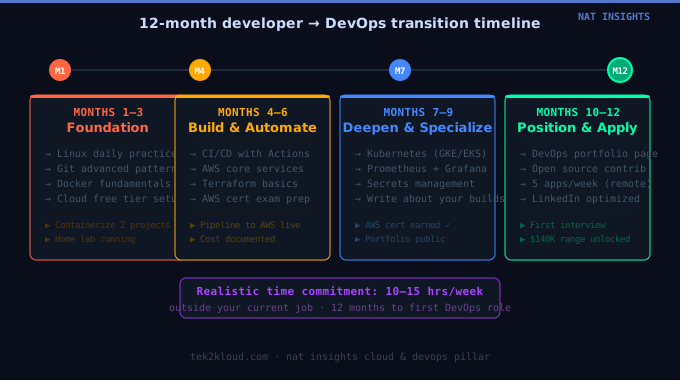
The realistic 12-month transition timeline
I want to be honest with you about time, because most roadmap articles aren’t.
MONTHS 1–3: Foundation
  → Linux fluency (daily terminal practice)
  → Git advanced concepts
  → Docker fundamentals
  → Set up a home lab or cloud free tier
  Milestone: Containerize 2 of your existing projects

MONTHS 4–6: Build and Automate
  → CI/CD pipeline with GitHub Actions
  → AWS core services (EC2, S3, RDS, VPC, IAM)
  → Infrastructure as Code basics (Terraform)
  → AWS Certified Developer exam prep
  Milestone: Deploy a full pipeline to AWS, document it

MONTHS 7–9: Deepen and Specialize
  → Kubernetes fundamentals (GKE or EKS)
  → Monitoring and observability (Prometheus, Grafana)
  → Security basics (IAM policies, secrets management)
  → Start writing about what you're building
  Milestone: AWS certification earned

MONTHS 10–12: Position and Apply
  → Build your DevOps-specific portfolio page
  → Contribute to open source infrastructure projects
  → Apply to 5 remote DevOps roles per week
  → Optimize LinkedIn for DevOps keywords
  Milestone: First DevOps interview landed
Twelve months is realistic for a developer with 2+ years of experience who commits 10–15 hours per week outside their current job. Less time per week means longer timeline. More focused intensity can compress it.
The engineers landing $140K DevOps roles in 2026 didn’t learn faster than you. They started earlier than you. The second-best time to start is today.
The one thing that kills most transitions before they start
It’s not the tooling. It’s not the time commitment. It’s not even the certifications.
It’s staying in tutorial mode indefinitely.
There is a specific trap that developers fall into when learning DevOps: consuming content without producing evidence. Watching Docker tutorials. Reading Kubernetes documentation. Completing AWS courses. All without building anything that can be pointed to, demonstrated, or deployed.
Two developers with equal technical ability can earn very different salaries if one communicates clearly and confidently — many skilled professionals lose global opportunities not because of technical weakness, but because of poor professional visibility. Medium
The same principle applies here, doubled. DevOps is an operational discipline. Employers are hiring for demonstrated judgment under production conditions — not course completion certificates. Every hour of tutorial time needs to be matched by an hour of building, deploying, and documenting.
Build the pipeline. Break it deliberately. Fix it. Write about what you learned. That cycle — repeated over twelve months — is what a DevOps portfolio actually looks like.
What this means for your career if you’re based in Africa
The global remote DevOps market is not a distant aspiration for African engineers. It is an active, accessible opportunity right now.
The average salary range for remote tech roles accessible from Nigeria currently sits at $3,500–$7,300 per month, with some companies offering up to $13,000 per month. At the DevOps specialization level, the upper end of that range is not unusual for engineers with solid infrastructure credentials and demonstrated production experience. Research.com
The barrier is not geographic. It is not even primarily technical.
The barrier is the gap between knowing how to do the work and being able to demonstrate — clearly, in English, to an international hiring manager who reviews 200 profiles — that you can do the work at production scale without supervision.
Closing that gap is exactly what this transition roadmap is designed to do. And for engineers who want a structured path through it rather than piecing it together from scattered blog posts, building that curriculum is exactly what we’re developing inside Tek2Kloud Academy. Follow NAT Insights to get first access when the DevOps track launches.
Start here. Not tomorrow.
Close this article and open a terminal.
If you’re on Windows, install WSL2 (Windows Subsystem for Linux). If you’re on Mac, you already have a Unix terminal. If you’re on Linux, you’re already home.
Run this:
bash
# Your first real DevOps command —
# understand every word of the output before moving on

uname -a && df -h && free -h && uptime
That single command tells you the kernel version, disk usage, memory availability, and system uptime. A DevOps engineer reads that output and instantly understands the health of the system they’re on.
Can you read it? If not, that’s your starting point. And it’s a much shorter distance than you think.
Nathaniel Edet is a Cloud/DevOps Engineer and founder of Tek2Kloud Solutions Ltd — a web development company and technical training academy building managed infrastructure and digital capability for businesses and professionals. NAT Insights publishes weekly on cloud engineering, tech careers, and digital business strategy.
Follow NAT Insights for the next piece in this series.
Over to you:
Where are you right now in this journey — a developer looking at DevOps, already mid-transition, or already on the other side? Drop your current situation in the comments. I respond to every engineer who shares a specific challenge.